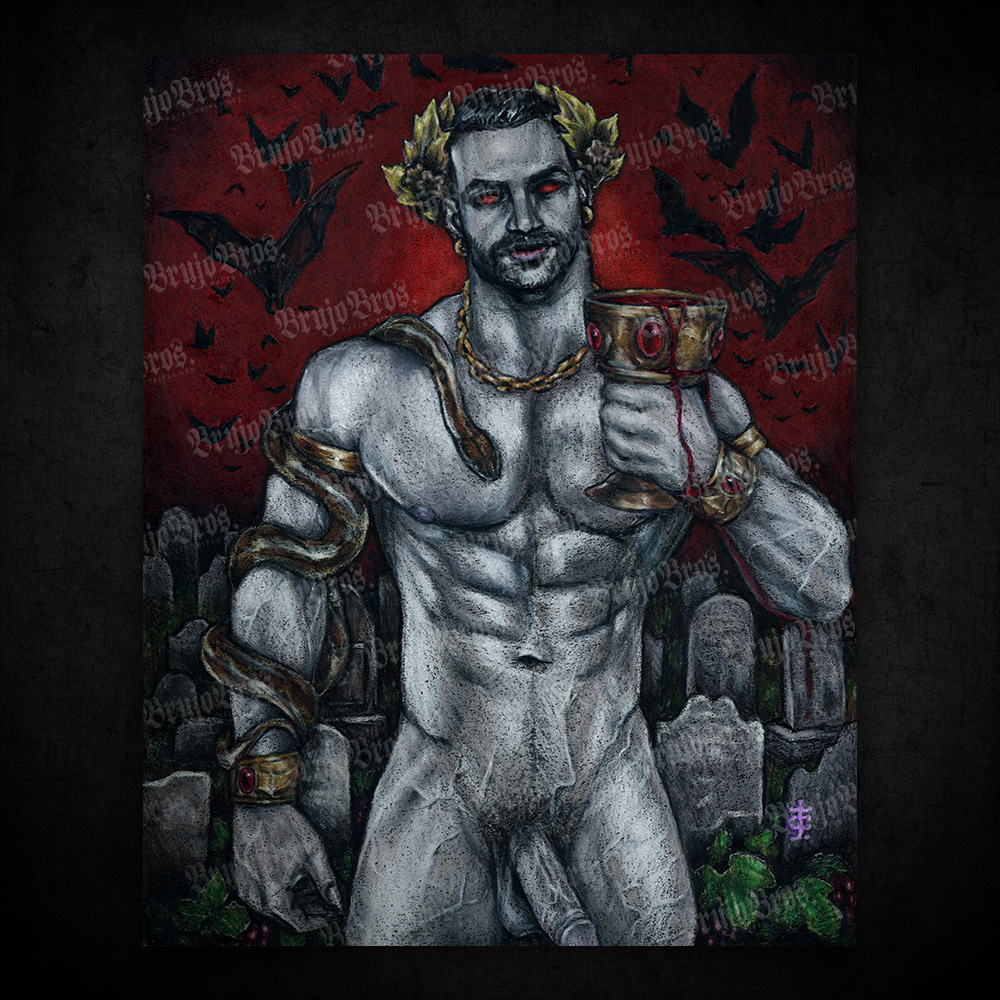
The Vampire, a supernatural being of immense power, has instilled fear in its many forms across the world. It is a monster, a demon, immortal, and terrifying. Known for drinking blood and consuming the flesh of their prey, vampire-like figures have been with humankind since the dawn of civilization. Often connected to the powers of the Underworld, their allure lies in their promise of immortality, and in more recent centuries, their potent sexual energy. Stalking the Night, the vampire lures innocent victims drawn to their magnetic beauty.
Most think of the names Hekate, Pan, Hades, or even Night-Wandering Dionysos, yet there is a God Who rules the Night, a Prince of the Underworld Who brings renewal and vitality. His name is Zagreus, meaning “Great Hunter,” and His life-giving powers are at their height this time of year before becoming that of Death and the Underworld. Here Zagreus revels with us, pouring into us the “zoe” or “life-force” of Nature, that immortal part of us all we call the soul. That is His gift. He offers us immortality past Death, and Summer is a reminder that we should enjoy life because the Death of Autumn and Winter will inevitably arrive long before we reach the rebirth of Spring.
A rather obscure divinity, the earliest myths from the 6th century BCE epic “Alcmeonis’ tells us Zagreus is one of the most powerful Gods of the Underworld, enthroned alongside Gaia Herself as the Highest of All the Gods (of the Underworld) when the character Alcmaon evokes His name to allow his father’s soul to be escorted safely into the afterlife. His parentage some 100 years later in the 5th century BCE, has Him as the Prince of the Underworld, the son of Hades and Persephone. Within the first few centuries CE, Zagreus begins to take on more attributes of Dionysos, being considered the God’s older form, a tradition specific to the Orphic Mysteries. Here He is the son of Zeus Who took on the form of a dragon or serpent to seduce Persephone.
Of course, as an offspring resulting from Zeus’s infidelity, Hera devised a plan to have the child killed by sending Titans to tear Him apart. They distracted the child with toys that included a knucklebone (an ancient form of dice), a ball, a jointed doll set with gold and jewels, a spinning top, an apple, a fleece, and a mirror. While Zagreus peered into the mirror, the Titans attacked Him with a cursed blade. Zagreus tried to escape by shapeshifting into the form of various animals, eventually subdued in the form of a bull. The Titans dismembered Him and set up a cauldron to cook the limbs. Bright-Eyed Athena witnessed the tragedy and stealthily stole the still-beating heart, which She gave to Zeus.
Upon discovering what had happened, Zeus threw the Titans into Tartaros and set the surface of the Earth ablaze in retribution for Gaia, Mother of the Titans. Zeus then gave the heart to His mortal lover Semele to revive Zagreus. He promised to never deny Semele anything she asked as a reward. Of course, Hera convinced Semele to ask Zeus to reveal His true form, that of pure Celestial Fire, and instantly turned Her to ash. In sorrow, the Son of Kronos sewed the fetus into His thigh, sometimes specifically the inner thigh, from which Dionysos received the phallic powers from developing in such proximity to Zeus’s manhood. The thrice-born Dionysos: first to Persephone as Zagreus, second to Semele as Bromios, and third from Zeus’s thigh as Iakkhus, or “Late-Born”, entered into the Divine world bull-shaped, with the horns of a bull. The original genitals of the first Zagreus were discovered by the Kabeiri, the dwarvish sons of Hephaestus, and brought to a cave in Samothrace, where the member became erect and stood as the symbol for the Mystery cult there.
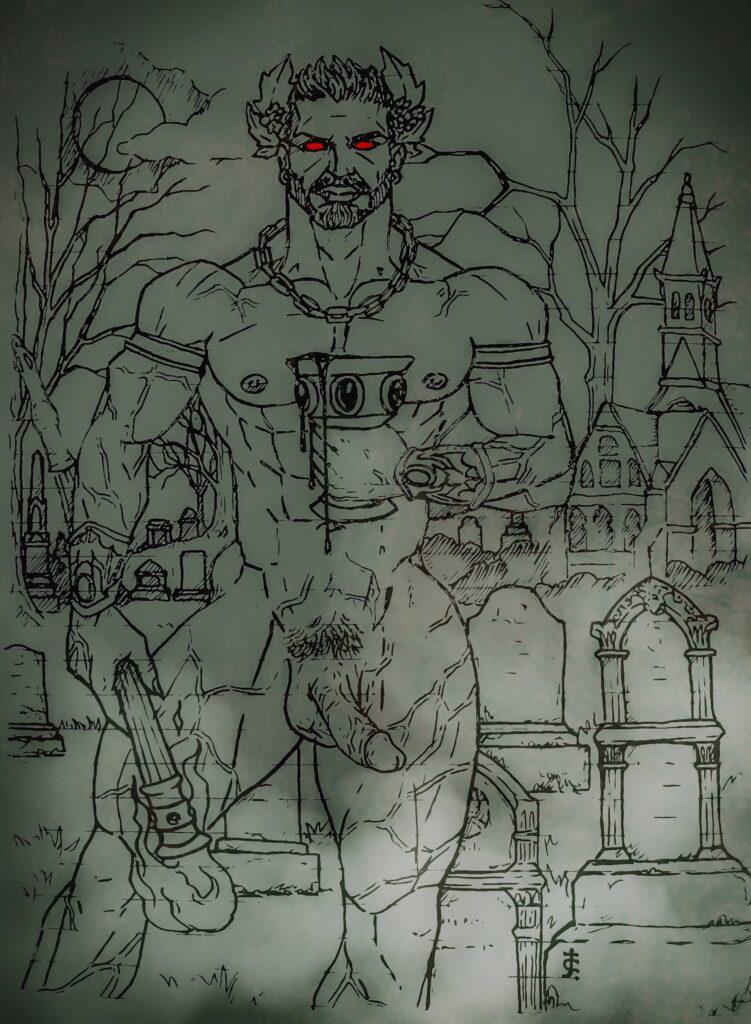
While the Orphic tradition maintains that Dionysos and Zagreus are two aspects of the same God, it is important to remember that Zagreus was a distinct God altogether, especially in earlier and non-mainstream cult. It was common practice in the ancient world to syncretize Gods, especially foreign ones. Zagreus is believed to hail from Crete, pre-dating the Olympian pantheon. In my personal cult I tend to honor Zagreus more related to His original status as a High Prince of the Underworld holding power of Death, Rebirth, and the Black Arts. Here He is a terrifying, savage God Who drinks warm blood and eats raw flesh from still living victims. In fact, His name not only references hunting, but specifically hunting where the prey is captured alive. The more brutal offerings sacrificed to Him in the ancient world involved tearing apart live animals, something we definitely don’t do today.
Zagreus as a powerful Underworld God persisted for hundreds of years, from that very first inscription from somewhere in the 5th or 8th century BCE, into the middle of the 4th century, where He retains dominion as an elevated Stygian God. He also sits on the liminal space between Underworld and Olympian, much like Hekate. Euripides mentions the “midnight Zagreus”, armed with Zeus’s thunderbolts. For a time, Zagreus was seen as the God responsible for nocturnal storms, rather than Zeus Who was more associated with the light of Day. In this same dialog, He is also still propped up beside Gaia, or Kybele, and celebrated with “red and bleeding feasts”. In fact, nocturnal orgiastic rituals filled with sexual carnality and dark witchcraft are a normal feature in the Zagreus cult, a reputation maintained up through the 5th century CE in “Dionysiaca’ by Nonnus mentions the “Egyptian Dionysos”, a name given to Zagreus due to His association with Osiris, and “nightly celebrations of mystic arts” and “magic hymns sung in wild secret languages” under the God’s patronage. He can be seen as a Vampire God, that life-force that flows in warm blood being sacred to Him. Blood as life-giving fluid was important in ancient witchcraft, in fact it was necessary to facilitate communion with the Dead in Necromancy. Fresh, living blood mixed with poisonous herbs injected into the veins of cadavers while reciting spells and incantations to Gods such as Zagreus and Hekate could restore temporary life in order to obtain oracles from the soul that has become privy to the secret workings of the Universe, able to see past, present, as well as future. Necromancy is an art sacred to Zagreus in that it is a temporary expedition of His cycle of Death and Rebirth, albeit temporary.
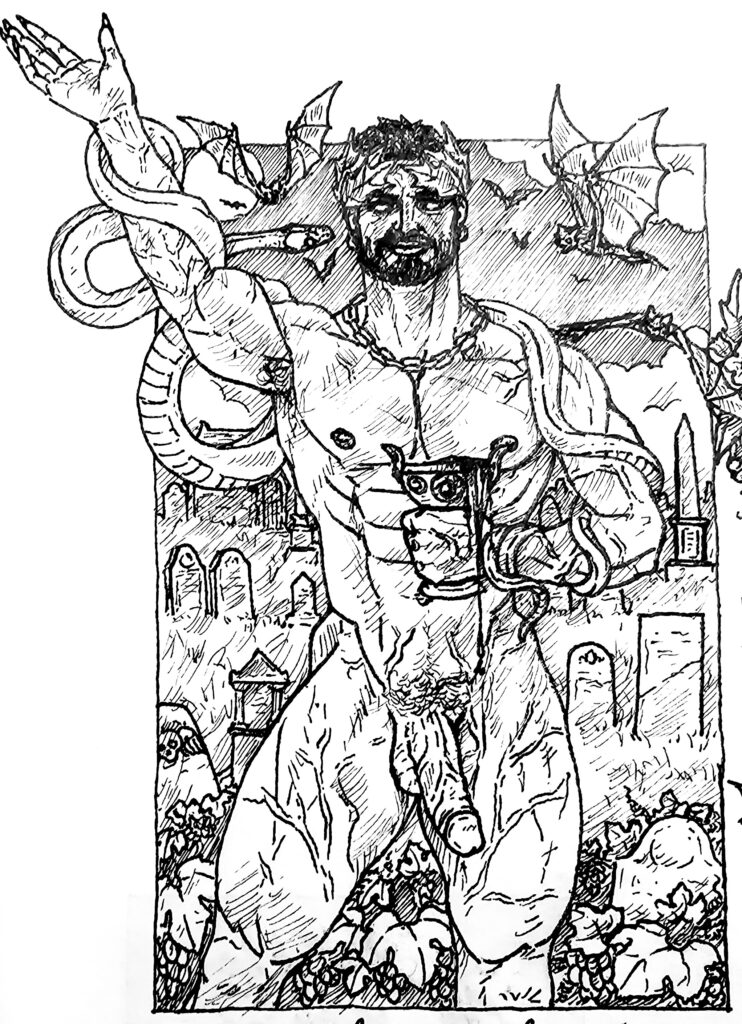
He is also an extremely potent phallic God, particularly the erect phallus. His altars were adorned with large erect penises, no doubt some early iteration of the erect phallus said to be kept by the Kabeiri. In fact, the oldest surviving altar dedicated to Zagreus dating from the 5th century BCE in Thrace is adorned with a large 28 cm (11 inch) phallus. It is a powerful symbol of enduring life and virility that perpetuates even after Death. Just as the penis becomes hard to generate the semen of life, and shrinks into flaccidity, only to repeat over and over, so too does the “zoe” through vigorous life, shrinking into Death, only to rise again through rebirth . His erect phallus represents not simply fertility, but renewal, and the cycles of regeneration of life on a cosmic level. It is the undefeatable, indestructible persistence of life itself, as well as that of Death and its finality of one phase of life to another.
Contemporary worship has been renewed based on pop culture, such as the 2020 video game “Hades”, by Supergiant Games. Impressively, the game’s developers delved deep into Greek mythology while developing the game, uncovering bits and pieces of academic history, bringing Zagreus back to His pre-Orphic form, even joking about Dionysos and Zagreus collaborating to make mortals believe They were the same God. Here, Zagreus is the Prince of Hades, true to mythology, as well as the Prince of Blood, a nod to His connection to life-force. In fact, pop culture is simply today’s form of mythology, and depictions like those of “Hades” become a part of the whole of His history. I personally have met many devotees who incorporate the imagery of the game into their worship.
This isn’t a foreign concept in world religion. The Fowler Museum of UCLA’s ‘Sacred Arts of Haitian Vodou’ by Donald J. Cosentino explains how Haitians today reference pop culture in Vodou. For example, Bawon Samdi, a Ghede lwa, is given the image of Darth Vader from ‘Star Wars’ as a sort of jovial nod to Death.
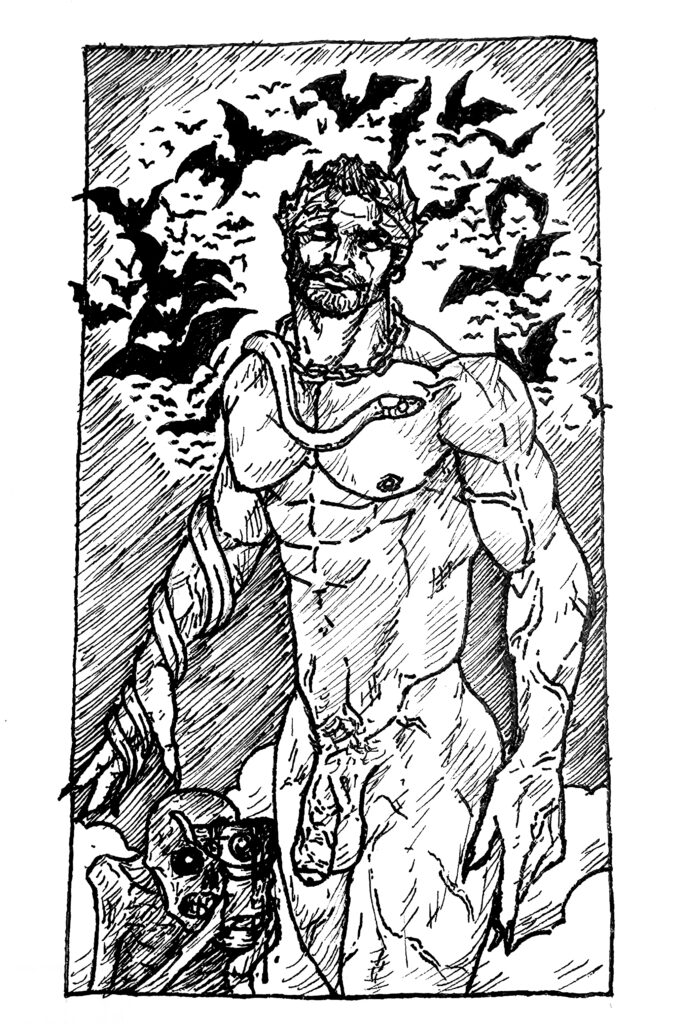
In Service of The Vampire God
Setting up service to Zagreus is something witches who thrive in Nocturnal revelry would benefit from. He is a God that works extremely well with traditional Witch Gods such as Hekate and Pan, playing a part in both of Their domains. More importantly, He is a God of the Marginalized, even considered to be homosexual, or at the least bisexual, much like Dionysos. In some gay covens, He is lovers to both Thanatos, as well as Eros, that is, Renewal in union with Death, and the Desire for Immortality.
In Hellenic cult, imagery plays an important role in manifesting the divine power, or “dynamis” of the Gods. Sacred statues or icons of the Gods are seen as sympathetically linked to the God they represent. Despite the Gods not having true physical form, as that which is eternal and immortal cannot be material, as all matter is subject to Time. This gives a profound liberty to devotees when it comes to depicting the Gods, that there isn’t one single “right” way. Artists across time have used their own Muse to depict the Gods in ways both conventional and unconventional. When it comes to Zagreus, there are zero ancient depictions that are specifically named as the God, in fact, most are of the Orphic Dionysos where Zagreus stops at being a child and becomes Dionysos the adult.
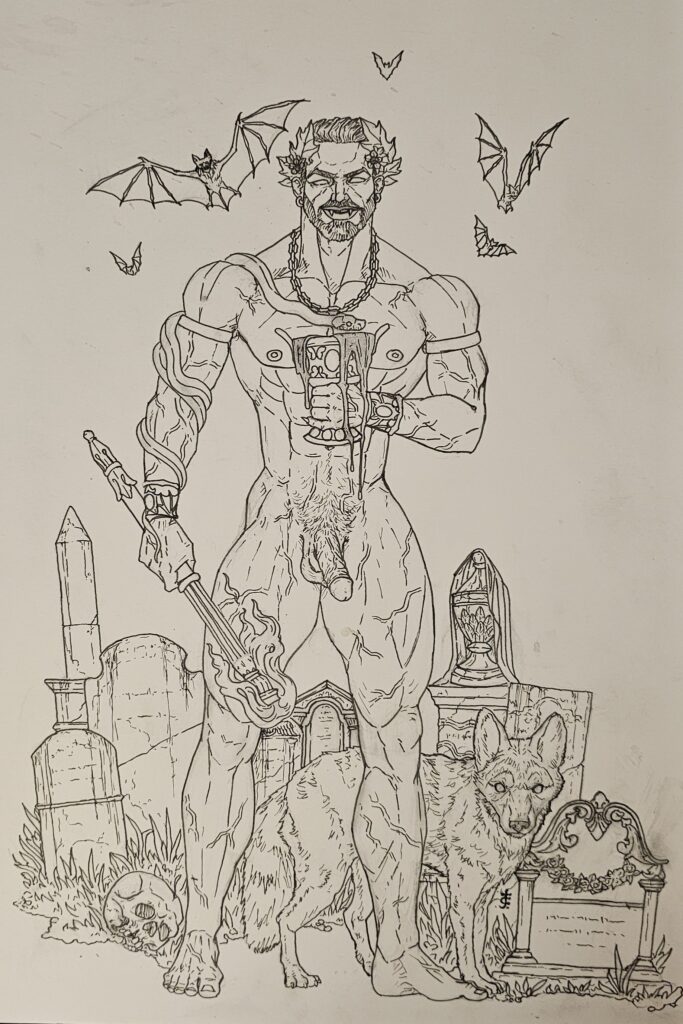
That leads to the question, what would an appropriate depiction of Zagreus look like? For one, according to Diodorus, in the 1st century BCE, He is the older of two distinct Dionysoi, and is bearded like men would have been of the day. Of course, as a God, He is well muscled, an ideal unattainable by most mortals. He can hold an inextinguishable torch, perhaps downturned, much like those on Victorian tombstones. This represents the immortality of the soul itself, that even after Death we endure. In His other hand, He holds a chalice of warm blood, sweet like wine. This represents the life-giving and life-sustaining powers of blood, a power that is said to be able to even bring back the Dead. This makes vampyric imagery appropriate.
Of course, images of Dionysos yet dedicated to Zagreus would also serve HIm appropriately. These statues can then be painted and adapted with Zagreus specific “symbola” that would make it identifiable as the God. There are also an increasing number of Zagreus statues available on the market today, so finding one that captures Him as the devotee best sees Him is becoming easier. That said, the sacred image doesn’t need to be a statue. It can take on the form of an icon, such as a print or illustration depicting Him, much like the icons used by the Greek Orthodox Church, or framed like we find in Eastern religion such as Hinduism, or the African Diasporic Religions like Vodou and Lukumi. As long as it speaks to the devotee and allows them to see the image as the presence of the God, that is all that is important.
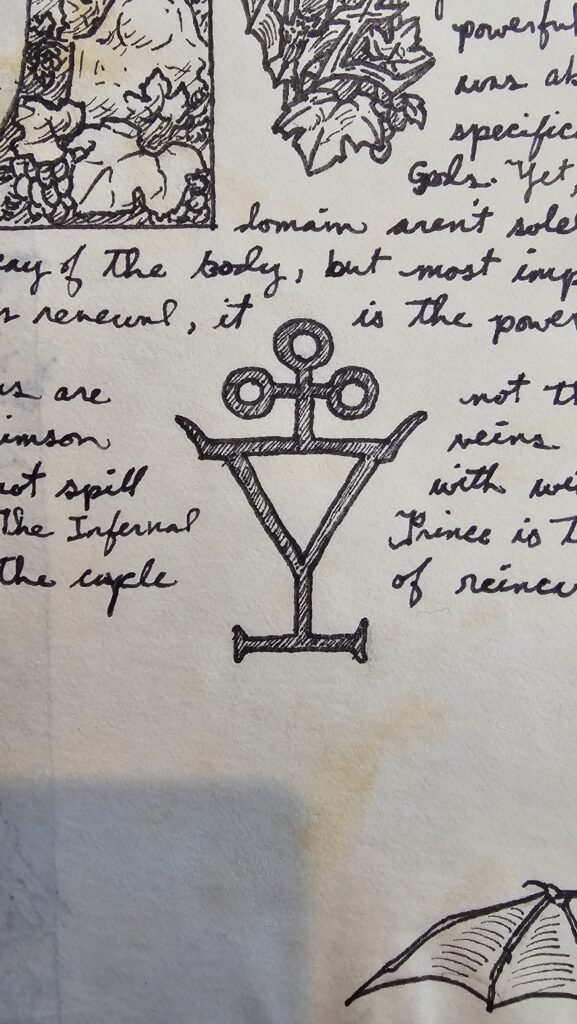
Once the image has been selected, the altar should be set. To best describe the process, I will explain how I arranged mine. First, I set a space that is shaded from Sunlight. It doesn’t have to be completely cut off from it, just not in direct line of it. As I always say, think vampire rules. I consecrate it by first washing it with a mix of spring water, and my Zagreus oil, then burn Zagreus incense to suffumigate the space. Once done, the agalma, or sacred image, sits in the back center of the altar, slightly elevated by a platform to create the area I call the “throne”. This is where He is enthroned alongside votive offerings that are not touched or interacted with. In other words, non-perishable valuables such as gemstones, coins, statues, jewelry, and so on. The altar surface is the working area where perishable offerings and libations are sacrificed. This area also includes the candles and tools used in cult. Here are my cult correspondences for Zagreus:
Colors:
-Black for the Underworld and Death.
-Dark maroon/purple for the promise of renewal, symbolic of wine.
-Red for life-force and blood.
-White for the virile semen.
-Grey for the grave and soul of the Dead.
Stones:
-Garnet is my main stone for Zagreus. It represents blood and wine, as well as the pomegranate which is said to have sprang from and contain His blood.
-Dark purple amethyst which, for my purposes with Zagreus, represents the occult powers of wine that bring one into an altered state. When I am looking at amethyst for Zagreus, I gravitate towards those that have bright blood red inclusions.
-Smoky quartz, specifically extremely dark, almost black. This represents the nocturnal storms He controls.
-Black stones such as onyx and rainbow obsidian are also used due to their connection with the Dead and Underworld.
Metals:
-He gets the typical Underworld metals of iron and lead, as well as bronze for its magical properties, and gold as a Prince.
Animals:
-In ancient times Zagreus was associated with goats, snakes, bulls, and wild dogs such as foxes. Foxes represent madness and frenzy, as well as the primal energy of ecstatic rites. His followers would wear the skins and hoods of foxes in order to almost shape-shift into the canine in order to relinquish their human side (because of this He is a great God for the Pup community alongside Pan Who is the God of dog packs). Animals that are associated with a lot of Underworld Gods are also in His retinue of familiars such as bats which represent nocturnal Mysteries and a hunger for blood, the screech owl which represents witchcraft and the Underworld itself, and dogs and wolves as heralds and guardians of the Dead.
Plants:
-Again, most of these plants are specific to most Underworld Gods. They include asphodel, or ghost flower, poplar, parsley, henbane, wormwood, pomegranate which is said to contain His blood, and aconite. Other plants that represent renewal and immortality such as lily, acacia, orchid, carnation, and ivy , as well as fig and cypress can be used for Him.
Recipes, Prayers, and Rites
Here are the recipes for the oil and incense used in His rituals. While here they are used to consecrate the altar, these are used whenever evoking and serving Zagreus.
Zagreus Oil
To one ounce carrier oil such as olive, grapeseed, or FCO, add:
10 drops cypress oil
40 drops dragons blood oil
5 drops lily oil
20 drops benzoin oil
10 drops vetiver oil
10 drops cedarwood oil
3 drops mugwort oil
3 drops patchouli oil
3 drops carnation oil
You can optionally add a small pinch of His sacred herbs to the blend.
Zagreus Incense
Grind together the following:
1 tsp benzoin of sumatra
1 tsp dragons blood
1 tsp black ethiopian
1 tsp manna (a resin from the ash tree)
½ tsp cypress
½ tsp lavender
½ tsp gum arabic
¼ tsp wormwood
¼ tsp pomegranate
To this add:
5 drops dragons blood oil
3 drops lily oil
2 drops orchid oil
1 drop mugwort oil
1 drop vetiver oil
A splash of red wine
¼ tsp pomegranate concentrate
¼ tsp honey
Mix and then let it amalgamate for 3 Nights.
Blood of Zagreus
Bring ½ cup water to a boil and add:
1 tbsp chopped fig
1 tbsp chopped sweet red cherries
1 tsp elderberry
1 tsp dandelion root
1 tsp orange peel
1 tsp mullein
½ tsp dried pomegranate seeds
½ tsp black tea
1 small pinch wormwood
Reduce heat and steep for 15 minutes covered then cool.
Add to this:
1 bottle red wine
½ cup pomegranate liqueur
¼ cup honey
This is a great libation for Zagreus, as well as a communion wine for rituals and gatherings.
The next section contains some of my personal prayers to Zagreus. I combined fragments from the Orphic Hymns to Dionysos with some personal inspirations from my experiences with Him.
“To Dreaded Zagreus I call! Dark Lord of Death, Decay, and Renewal, Blood-Drinker, Flesh-Eater, Night-Wandering God, exalted in Hellish Hades, the Dead bow to You, Prince of Shades, You wear a crown of henbane, and Your strong limbs are adorned with writhing serpents. The sepulchral throne on which You sit, set with decaying skulls, is encircled by Night creatures, You keep court with corpses, You are the crucible of souls, holding aloft Your blazing torch to give praises to Underworldly Gaia, for through You all is renewed! Through You, Death brings Life, and Darkness brings Light! You are the Mystery of the Grave and the Immortality of the Soul! Khthonian Son of Grim Hades and Persephone, accept my sacrifice and grant to me purification from evil, renewed strength, and the occult knowledge of Erebos! By Your will and mine, it is so!”
“Come, Stygian Prince of Cadavers, Flesh-Devourer Who drinks warm blood, Merciless Spirit of the Slaughterhouse, Daemon of Morgues, You Who haunts the graveyard at Night, keeping course with Terrifying Hekate, Your palace is a mausoleum, its marble stairs descending into the depths of the earth to Your grim throne. Lord of Darkness, Zagreus, Master of Death, Decay, and Renewal, Vampire, Immortal, madness is Your ecstasy, Your revelers wear the face of foxes and wild dogs, conjuring the Hounds of Hell, all Night creatures swarm around You, Majesty of Witchcraft, giver of eternal life through the euphoria of Death! Hail to You, Noble Son of Hades and Persephone, Dread Lord of Ghosts and Shades, accept my sacrifice so I may receive the wealth of the Underworld, and be granted freedom from the grave!”
Rite to Zagreus At the Summer Solstice
Now that you know Who Zagreus is, and how to serve Him, here is a rite that can be done either alone or with others to honor the God as the force that grants life and renewal, taking in these powers at their height during the Summer months. It is a ritual that recognizes and honors that while life is thriving around us, Death slowly draws closer and decay is already progressing. While this seems ominous, it is a celebration of the life we still have, making sure we do not take any moment we have for granted.
This ritual is to be performed at Night when the Sun has fully set. Prepare by setting up a sacred space outdoors (although indoors will work if you cannot, just keep windows open). The main ritual image can be either a statue, or a mask, because like Hekate, Zagreus was often honored in the form of a mask. Set up the altar with a black or burgundy cloth, and having made the Zagreus oil, incense, and Blood of Zagreus libation, set the altar with a chalice, censor for incense, and a bowl of spring water. Decor should be phallic, and Underworldly. Images of erect penises, skulls, bats, wolves, and so on are appropriate, and fruits such as black grapes, black figs, and pomegranates should sit among garlands of grapevines and ivy. The scene should be set with torches and black or red candles.
This is a ritual of a frenzied Underworld God so the encouraged dress should be black, comfortable, or even nude. When ready, the participants should gather around the altar. Burn the incense and walk around the perimeter three times, making sure anyone attending is within the circle. Next take the oil and pour some into the spring water. Light a black or red candle and salute Zagreus saying:
“Death to Life, Darkness to Light, Zagreus of Hades, Highest of Infernal Gods, let this light carry within it the promise of immortality, and the renewal of the soul persevering in this life, and the next!”
Extinguish the candle in the water to create what is called “khernips”, or “lustral water”, our version of Holy Water. Using your hand or sprig of mugwort, do the same asperging the perimeter, then those attending, and finally the altar and image. You may call upon the 4 directions if you choose:
“Hail Euros, Wind of the East, open now the Gates of the Rising Sun! We summon and stir the Watchtower of Hyperion, attend and protect this space! (all) Hail and welcome!”
Turn to the South doing the same:
“Hail Notos, Wind of the South, open now the Gates of Mist and Haze! We summon and stir the Watchtower of Krios, attend and protect this space! (all) Hail and welcome!”
Turn to the West:
“Hail Zephyrus, Wind of the West, open now the Gates of the Setting Sun! We summon and stir the Watchtower of Iapetos (Ee-ah-pet-os), attend and protect this space! (all) Hail and welcome!”
Turn to the North:
“Hail Boreas, Wind of the North, open now the Gates of Ice and Shadow! We summon and stir the Watchtower of Polos, attend and protect this space! (all) Hail and welcome!”
Return facing East:
“The Shrines of the East are open! The Shrines of the South are open! The Shrines of the West are open! The Shrines of the North are open! The Shrines of the Celestial Heavens are open! The Shrines of the Black Earth are open! All Ye Gods of the Grove, All Ye Gods of the Night, attend here and bless this ritual! By our will and Yours, this circle is cast! (all) So mote it be!”
Go to the altar and evoke Zagreus:
“Hear us/me, Unliving Gates of Hades, mournful place where the Dead roam, unclasp the Seven Locks, and throw open the Seven Hinges so our/my words may cross the Seven Thresholds to He Who sits upon the Throne of Cadavers, to Zagreus, Infernal Prince, Vampire Lord of Renewal and Resurrection! Hail to You,Blood-Drinking, Gore-Eating Zagreus, Lord of Darkness, Sepulchral Prince of Corpses, enthroned in the graveyard among the tombs, bringing renewal and immortality, nocturnal creatures are dear to You, for even now as life thrives in the heat of the Sun, You stir beneath the earth, heralding the approach of Death! Attend this space we/I have prepared for You, set with ornaments of Dis. Let us/me celebrate You while we/I are/am granted the time to do so before Black Atropos presses upon Her sheers to see our/my thread is cut! As we/I gather here, among Dark Spirits and Restless Dead drawn here by our revelry pour forth Your blessings from Your golden cup stained with warm crimson so we/I too may defeat the finality of Death! Accept this libation and be present as Lord of this Sabbath!” *pour the libation to Zagreus, then invite participants to get a small cup of it for its blessing.
Once evoked, the revelry starts. There should be music, excitement, and even debauchery. Rites of divination and witchcraft can be performed, but it should be a Bacchanal of celebration. Ideally it should last until the first light of the Sun is seen on the horizon. At that point, pour His libation directly on the earth, and cover His image or bring it inside. As a God, there is no need to bid Him to depart as He is not bound to the space, but invited as an honored guest.
Zagreus is an often neglected God, even more so when He is conflated with Dionysos, losing His own identity in the process, however He is one we can rediscover, and bring into our cult to witness His overwhelming power to renew our life-force, rejuvenate our soul, and enhance our witchcraft.